

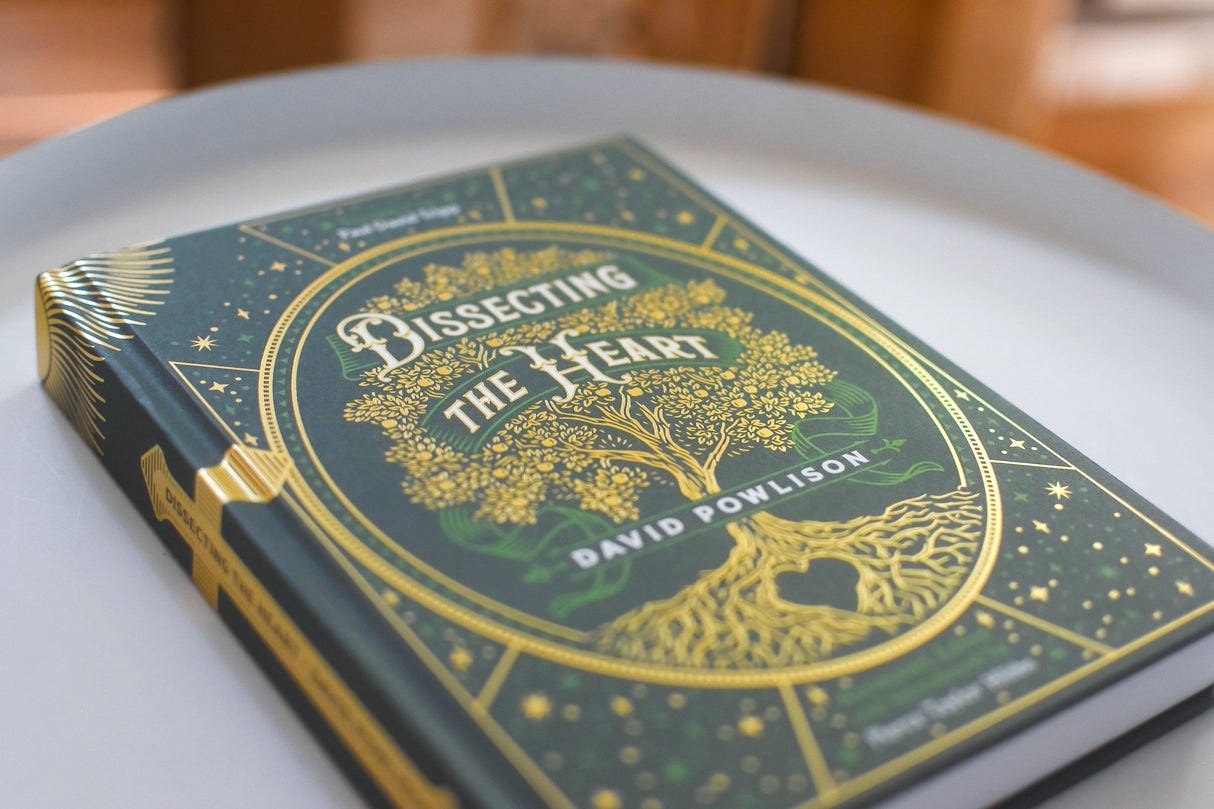
Dissecting the Heart: Secular Psychology, Spiritual Warfare, and True Theology by David Powlison (1949-2019) comes to us from Westminster Seminary Press with an anticipated publication date of October 2026. Within this volume, Pierce Taylor Hibbs (editor) packages about a dozen of David Powlison’s seminary lectures from before and after the turn of the millennium. The content will stir the hearts and minds of Christian readers regardless of your proximity to the biblical counseling movement. Overall, the book is highly recommended for its practical theology and timely reminder of enduring truths that the modern biblical counseling movement must take note of given her present trajectory.
Summary and Features
Hibbs refers to his labor as “a very special book.” I grant him a hardy, “Amen!” on his assessment. Since the book consists of lectures, it contains a very intimate feel throughout each page. While reading it, I felt more like I was auditing a seminary class than reading a theological work. I heard the wisdom of the professor without having to take an exam or write a paper! Despite the less formal feel, do not be mistaken, the book is theologically rich. Lastly, another feature that made the book a bit more intimate than most is a small introductory chapter titled “The Heart of David Powlison,” written by his widow, Mrs. Nancy Powlison.
The subtitle, Secular Psychology, Spiritual Warfare, and True Theology, provides an outline for the book’s construction. Part One consumes nearly half of the book’s length and addresses secular psychology, including a brief history of how men like Freud, Jung, and others explicitly and intentionally sought to usurp pastors as it pertains to their duty of caring for the soul of man. Here, Powlison addresses the Church’s feeble response to their attacks throughout the twentieth century but does not leave the Christian without hope. He urges his students to see the current landscape of counseling as endless opportunity for Christ rather than monopolized secularism. Within this section, Powlison provides autobiographical details of his education as a psychologist, resulting in his four years of employment in a psychiatric hospital. His experience led him to conclude that psychology cannot help people change in truly meaningful ways. God’s providence in David’s life uniquely equipped him to dissect the mind frames, motives, and methods of secular psychologists. If you are a student of psychology, biblical counseling, or consider yourself an integrationist (mixing secular practices and principles with biblical practices and principles), Part One will stimulate your thoughts on counseling theory while calling you to consider what biblical fidelity looks like in counseling practice.
While in Part One, Powlison resoundingly shows his academic capability, in Part Two, Spiritual Warfare, Powlison reveals his immense theological prowess. The entirety of this four-chapter section graciously argues against the practice of what Powlison calls the Ekballistic Ministry Mode (EMM). The term ekballisitic refers to “casting out” which is commonly utilized in the phrase “cast out demons.” The context of these lectures is Powlison’s observation that certain counseling movements within Christianity train people to handle issues of the heart by identifying, naming, and casting out a demon, instead of acknowledging, accepting, and mortifying besetting sins.
Within this section, all scholars should take note of how well-read Powlison is on the topic he argues against, adding strength and integrity to his argumentation. Additionally, he is intelligent enough to not simply group everyone who believes in naming, rebuking, and casting out demons into one “radical” or “crazy” group. Instead, he weaves recognition of merit where merit is due within his encompassing critiques of the movement. And yes, he names names without ad hominem. Pastors, authors, scholars, and bloggers should learn this valuable lesson from Powlison as it promotes genuine unity within the universal body of Christ while still hashing out important areas of disagreement.
Lastly, pastors, authors, and writers should borrow Powlison’s form as he surveys the entirety of Scripture to display the normative pattern for dealing with demonization: resisting him through humility, alertness, self-control, awakeness, the casting of cares and pressures on God, and standing firm in the faith through prayer and repentance (Ephesians 6; James 4;1 Peter 5). For those who are quick to respond to the reality that Jesus cast out demons in His earthly ministry, Powlison does not leave your accurate assertion unaddressed. He masterfully navigates the pages of Scripture to show that before and after Christ’s earthly ministry, God wills His people to utilize different and superior modes of dealing with “monolithic” evil (Satan, flesh, and the world) than in Jesus’ day.
Parts One and Two present Powlison as a capable academic and theologian respectively but Part Three reveals Powlison the Shepherd. In Part Three, True Theology, Powlison provides exegetical commentary of Psalm 131 and Psalm 10 respectively. These chapters are calming to the worrisome soul and comforting to the suffering saint. If you have ever heard or experienced biblical counseling as simply a pastor reading Bible verses and telling you to go and do likewise, read Part Three to see the true spirit and demonstration of what it means to counsel biblically. In the final chapter, Hibbs provides a short sermon that David Powlison preached to first year seminary students from the late 90’s. Here, the erudite Powlison makes the following comment,
“One of the temptations that comes with education in something as powerful, true, and life giving as the Bible is thinking that acquiring and displaying knowledge is what it is all about. And we become opinionated and exclusive and hardhearted. We need sweetening and softening and tenderizing. It’s the ugliness of intellectual pride, the vapidness of thinking that knowledge equals wisdom, and it doesn’t.”
Such blunt wisdom corresponds with the Bible verse that Mrs. Nancy Powlison said often reminds her of her late husband in her introductory chapter: Daniel 12:3, which says, “Those who are wise will shine like the brightness of the heavens above, and those who lead many to righteousness like the stars for ever and ever.” Certainly, David Powlison was a wise counselor whose lectures display Christ-centered thinking leading to Christ-centered living resulting in Christ-centered counseling.
Strengths
The greatest strength of the book is its relevancy to comment on modern issues and help those within today’s biblical counseling movement. Although this strength is the effect, we must examine the cause of this phenomenon. Why is Powlison’s work from 25+ years ago so relevant today? The sufficiency of Scripture. When Powlison dissects the human heart, models of secular counseling, and errors of EMM thought life, he wields the enduring truth of God’s word. While he is clearly familiar with secular modalities of counseling, he does not dabble in man’s vain philosophy but time and again holds each societal thought, counseling practice, theological teaching, and most of all, heart motive, up to the Holy Bible. When he sees error, he corrects. When he sees alignment, he develops beyond theoretical and pushes to the practical. Today, the biblical counseling movement is enamored with two extreme ends of the spectrum. One end near-endlessly critiques secular psychology to the point of ill-equipping their practitioners to care for souls. On the other end, counselors are working so hard to glean all they can from secular psychology that they, knowingly or not, are importing pagan sophistry into the Holy Church. To the former, Powlison would say,
“Who is it that has really thought through the hands-on, patient, roll-up-your-sleeves, get-into-people’s-lives process of human change and development—where it’s not one-and-done or a quick fix? Where it’s not throwing a Bible bomb at somebody and watching them change? Who has actually thought about how you build relationships so that people trust you, they open up, and you bring truth to them? Who really has a feel for people and what makes them tick? It seems to me that Christian faith has been squeezed out to the margins of significant discourse about people and a cure for what ails us. And so there’s a lot of being derivative in our models, a lot of failures to really have a robust alternative. We’re not on the ocean liners. We’re out on these little lifeboats of religiosity that Christian faith is supposedly about.”
To the latter, Powlison would say,
“The church has largely taken cues from the models and systems that are prevalent in the culture. Churches have been structurally subordinate to the secular professions we have been discussing. The God of Scripture has not always been the real authority for the church. The real authorities are not the pastors or shepherds looking to God’s word; they are a set of professions outside the church.”
Powlison’s clarion call to both ends of the spectrum is the major strength of this work: We, as pastors, counselors, and Christians, can take a helpful cue from the secularists by deeply investing our greatest resources into understanding the nitty-gritty issues of real life and its heart deep motivations like they have done without borrowing an ounce of their worldview or compromising our own.
Secondly, and again, one of the strengths of the book is its intimate nature. The fact that these are lectures make the book practical to a wide audience. Professors, pastors, and parishioners can capably handle this work and apply it to their research, sermons, and daily Christian walk. Powlison’s anecdotes keep the reading fresh, provide practical insights, and make the content of each lecture memorable beyond your reading hour. Plus, his application of systematic theology gives renewed insight to the applicability of God’s attributes, including His wrath and grace.
Thirdly, this book teaches you how to be a better Christian thinker. For example, in the latter third of the book, Powlison asserts that we, as finite creatures, come to God, the Bible, and the human experience seeking answers but lacking the ability to even ask the right questions. Throughout the remaining lectures, including the two appendices, he fleshes out a few helpful examples. Since reading this book, I have been thinking very differently when I read my Bible, serve my wife, disciple my children, interact with my congregation, and enjoy private prayer. The summation of the book teaches the reader not to isolate themselves from the cosmic context of good vs. evil, for we are not aloof onlookers, but active participants in God’s sovereign will unfolding. Two appetizers from the book that promote better Christian thinking is Powlison’s assertion that the 150 canonical psalms are the “psychology of Jesus” and that “Jesus is the incarnate version of the eight beatitudes.” These are deep and paradigm-shaping thoughts.
Weaknesses
I humbly cite a potential weakness in this writing, which should not deter you from reading the book. During the Secular Psychology portion of the book, Powlison often critiques the church for providing what he calls “pat answers” and “quick fixes.” Undoubtedly, there is validity in his critique; however, as a pastor and biblical counselor myself, each time I read his critique I wished he would explicitly extrapolate on his statements. Powlison critiqued merely telling a parishioner to “have quiet time and it will be okay,” while also affirming the necessity of quiet time with God. It would have been helpful to hear how he would explicitly connect some of the spiritual disciplines to the human heart. In my ten years of biblical counseling, including earning degrees and certification, I have always been taught to give your counselee a homework assignment centered on God’s word that is relevant to the need of the hour. I walked away from a couple chapters of the book stimulated to know how I can better assign this homework to ensure I am not providing “Bible bombs” and “quick fixes,” yet unanswered in my heart’s inquiry.
With my critique in hand, I provide you with two alleviating thoughts. First, I think this weakness is a result of the chapters being lectures, and unfortunately, we are not afforded the opportunity to raise our hands and ask clarifying questions at the end of class. Secondly, one can infer a little of how Powlison would respond to my inquiry by reading his lectures that work through Psalm 131 and Psalm 10. Similarly, the footnotes reference many other published works of Powlison that provide insight to how he would work past “pat answers” and “quick fixes.”
Something You Just Have to Deal With
Speaking of footnotes, herein lies what I cannot call a weakness but something you must deal with: the footnotes. Okay, they are not a weakness, but they are certainly something to be dealt with. Pierce Taylor Hibbs has gone to extraordinary lengths to provide meaningful footnotes throughout this work. Many times, Powlison references an event modern to his time that we may be out of touch with today, especially a younger reader. In these instances, Hibbs provides a footnote providing context. Hear me clearly: Hibbs’ footnotes are helpful and packed with outstanding content. The trouble? There are so many of them it is dizzying at times. I do not think it proper calling them a weakness, but you must know they are a prominent feature of the book. My advice is that as you read along, pick and choose which footnotes to investigate based on when your interest is piqued or when you need context for better understanding.
Closing Comments
My ministerial passion is biblical counseling. Within this calling, I often feel the pressure to know everything about everything within my human limitations. How else will I will be able to help everyone with everything? While the Lord has humbled me by reminding me that He is the omniscient One, Powlison shows us the truth that an effective biblical counselor must be far more than a one-trick pony. From the pens of Mrs. Nancy Powlison and Pierce Taylor Hibbs, we see that this man of God was first a worthy Christian husband and father, then an incredible academician, theologian, pastor, and apologist, resulting in his becoming a counselor of counselors. Still yet, from the mouth of Powlison to the pages of Dissecting the Heart, the reader is not left with a sense of how great David Powlison was, but rather, how faithful and gracious the God of David Powlison is to His people. Dissecting the Heart: Secular Psychology, Spiritual Warfare, and True Theology is a book that you, pastor, counselor, and Christian, should include in your fall 2026 reading.
Looking forward to reading this. As a neurologist, I end up not just treating the brain issues, but quite a bit of spiritual and mental troubles as well. Thank you for this book review.