

Introduction
There is a big hubbub going around in the evangelical and reformed world, debating the concept, reality, essence (whatever you want to call it) of faith. Perhaps this debate has escaped your notice – consider yourself fortunate. But for those of us who have been aware of it, and have been bothered by what we have seen people say who belong to the reformed tradition, I hope to provide (perhaps) a little clarity to an unnecessarily murky situation.
A Splash of Perfume
What is faith? This seems to be a notoriously difficult question for people to answer. The reason for this (as I see it) is because Christians desperately want to avoid the notion that faith is a work, but also want to remain biblical seeing that works are essential to faith – or at the very least faith cannot exist apart from them. And this makes sense. The church came through a reformation some 500ish years ago, with this as a central issue to the thing.
Nevertheless, we need an answer. What is faith?
Well, some will say, “psshhtt. Thats easy. Faith is a gift of God.” True enough. But that’s not so much what it is, but could be better suited to explain the category faith falls in to. It’s a gift rather than a non-gift. It was given rather than gotten. You didn’t earn it. It was given to you, freely from God in heaven. Case in point:
Ephesians 2:8 For by grace you have been saved through faith. And this is not your own doing; it is the gift of God
2 Peter 1:1 “Simon Peter, a servant and apostle of Jesus Christ, To those who through the righteousness of our God and Savior Jesus Christ have received a faith as precious as ours.”
Philippians 1:29 “For it has been granted to you on behalf of Christ not only to believe in him, but also to suffer for him”
So, it is evident, beyond any doubt, that faith is a gift. But still, that’s not what faith is. We want to know what the metaphysics of faith is. God gives it, but what, exactly, is he giving? Is he giving and idea? An ethereal conception? A steaming blob of heavenly goo? Is it something akin to a corpse waiting to be resurrected? What exactly is the being of faith, so to speak?
This is the crucial question of this post.
There are many who will say exactly what I said above, that faith is an idea, etc. but it’ll be whitewashed and made to look pretty and it will be given a splash of perfume to try and entice you to believe it. They’ll say that faith is passive, doing nothing (not obeying) until a person is justified, and then the faith becomes active and obedient immediately afterward. In other words, there will be a moment in time when faith is given to a man, but it is not doing anything – they’ll say it is passive – and then once that man is justified the faith becomes active. Once it is active then it produces the works prepared beforehand for it to produce (Ephesians 2:8-10). And this must be the way to understand it because to understand it in any other way would be to suppose being justified by works. And you wouldn’t want to contemplate a possibility of being justified by works do you? Unfortunately, what is articulated here, as we will see, is that passive faith is not a biblical possibility to produce justification, because passive faith is dead faith.
What Is Faith? Not What It Does, But What It Is
So, what is faith?
The bible gives us a definition of faith in Hebrews saying,
Hebrews 11:1 “[F]aith is the assurance of things hoped for, the conviction of things not seen.”
Again, this is true and helpful as far as it goes. But what does this mean? Paul says that faith is “assurance” and “conviction”. But this translation is misleading. The word interpreted “assurance” is hypostasis in the Greek, and does not mean assurance, but rather it means “a standing under; a taking of a thing upon one’s self; an assumed position, an assumption of a specific character.” In other words, faith is character, or it is taking a particular posture or position in life.
Like “assurance” the term “conviction” can also be better translated as “evidence.” It is the Greek, elegchos and means proof or evidence. Our faith, is evidence of things unseen. Faith gloriously allows the faithful to see things with the soul that would otherwise be unseen to the eye. But if it is evidence, what does the evidence look like? How do we understand it when it presents itself? Is it a feeling? A thought? Is it tangible? Is it ethereal? How does this evidence manifest itself in our life that we may know it when we see it?
Each of these senses of faith finds its place in the context that follows verse 1. In the remainder of Chapter 11 Paul lists several saints, Abel, Enoch, Noah, Abraham, Sarah, Isaac, Jacob, Moses, Rahab, et al. And all these servants of God did amazing things “by faith.” In the context, we are to be encouraged by them because we can see their faith working as they did what God commanded them. It is important to note, however, that we don’t see their faith producing works, rather, we see their faith working. And this is an important difference. We see these men and women assuming a posture of fidelity, and producing evidence of their regeneration “by faith.” We are meant to see that their faith was genuine, because their faith is on display in their obedience to the Lord. To put it another way, their faith wasn’t producing works, it was working itself. Their faith is what sought a better home, rather than their faith producing in them the desire for a better home. Moses’ faith is what considered the reproaches of Christ greater than the treasures of Egypt, rather than his faith producing that obedience.
In other words, as Donald Macleod said, “Faith is not the qualification for coming to Christ. It is the coming itself.”
Fat, Dumb, and Happy
Two other helpful texts in scripture which illuminate our hearts to understand faith better are found in Romans 1 and James 2. Regrettably, however, rather than allowing these texts to speak for themselves and guide our theology, there are many who have form-fitted them into already existing theological frameworks, like sugar paste being pressed to look like gumi bears. Although delicious to the pallet they wreak havoc on the gut. In the same way we want the Bible to say what God has said, so we don’t find later, that while we sit fat, dumb, and happy, our soul and mind are in turmoil.
In Romans 1 Paul says,
Romans 1:5 “[T]hrough [Jesus] we have received grace and apostleship to bring about the obedience of faith for the sake of his name among all the nations”
Paul says expressly that the purpose of the grace he received and the office he maintained was to “bring about the obedience of faith…among all nations.” Sounds very Great Commissiony if you ask me. But I digress.
It is important to note, that the word translated “faith” is the Greek, πιστεως, which here is in the Genitive case. The genitive case in Greek denotes possession or ownership. This means that verse five, which reads ὑπακοὴν (obedience) πίστεως (faith) possess the preposition of the sentence it is in, which is this case, is the obedience that precedes it. The translators understood that Paul is saying that obedience is owned by, or possessed by faith, hence the translation, “obedience of faith.” In other words, “obedience is joined with faith, because by faith we obey the commands of God; and faith itself consists in obedience, and is the great command of the gospel.”1 Therefore, the word “of” is employed.
So what does the “of” mean? Here Paul indicates that obedience is of faith. On this and other passages like it, many theologians like Steve Lawson, Burk Parsons, R.C. Sproul, et al will say something like this: “obedience is a fruit of faith” or “obedience is proof of a lively faith” or “our works justify our claim of faith before our fellow man.”2 Notice what is actually being said here. In these formulas obedience is not an integral component of faith, but rather it comes after faith; obedience is the product of faith, not a “possession” of it. So, imagine, for a moment, this formulation being strewn out on a table. It would look like this: someone would have faith, and for a time it would hum along, moving on the imaginary timeline and - for a time - it would produce nothing (it would be present yet passive in the person), then at some indeterminate time in the future after the faith was given, it would produce the fruit of obedience. In this picture faith and the obedience it produces are necessarily not the same thing. They are joined, but separate, because in this scheme faith must exist before its fruit can exist. Just like a tree with its apples. They are necessarily joined, but the tree existed before the fruit. But notice what is happening. No longer is obedience of faith, as Paul says, but now obedience is produced by faith. These are radically different things.
This can get a little complicated because of the multi-various ways the word “of” can be employed. The word “of” can be used to indicate an association between two entities – I am the son of my father. This is how many use it, and how the men above have explained it. In this picture, there is merely an association, one issues the other. However, the word “of” can also be used to express the relationship between a part and a whole – the roof is part of the house. This is closer to the way it is employed in Romans 1:5. Obedience is of faith. It belongs to it, its part of it, it’s woven into it, it’s a crucial aspect of what faith is, faith couldn’t exist without it, etc. To take away obedience from faith is the same as taking away a roof from a house – it’s no longer a home, it’s just empty space with four walls masquerading as an abode.
Obedience thus being woven into faith, it is no longer a fruit borne sometime in the future of faith, but is an integral part of it, existing along with it from its very inception.
Elsewhere, our Lords brother is likewise compelled to give us the nature of faith. He says,
James 2:24 ”You see that a person is justified by works and not by faith alone.”
Many of the modern day reformed folk look at this passage and, with a desire to reject any notion of works being part of justification, will claim that James is using the word "justify" to mean, “to demonstrate or show to be righteous, or to vindicate oneself to those around him.”3 In other words, the fictitious man represented here proves himself (or is justified) to those around him (horizontally) by the works that he does, which prove that he has genuine faith. His profession of faith is vindicated toward his peers by the works he performs, because they are proof of its legitimacy. The cause of this interpretation is what James says in v15-18 of the same chapter.
If a brother or sister is poorly clothed and lacking in daily food, and one of you says to them, “Go in peace, be warmed and filled,” without giving them the things needed for the body, what good is that? So also, faith by itself, if it does not have works, is dead. But someone will say, “you have faith and I have works.” Show me your faith apart from your works, and I will show you my faith by my works.
It is James’ last line that is most crucial, “Show me your faith…and I will show you my faith.” This is clearly horizontal. So, their conclusion is true as far as it goes. But the error made here, as I see it, is not that they recognize the horizontal element, but that they believe it is entirely horizontal without any notion of vertical. They err in assuming their interpretation is carried all the way to v24 whizzing effortlessly through v20-26, and they neglect the context of the passage, which is final judgement and the question of whether a faith with no works can save. (James 2:13-14).
The Vertical Element
The following verses show – without the need to squint – the vertical element of justifying works.
V21 “Was not Abraham our father justified by works when he offered up his son Isaac on the altar?
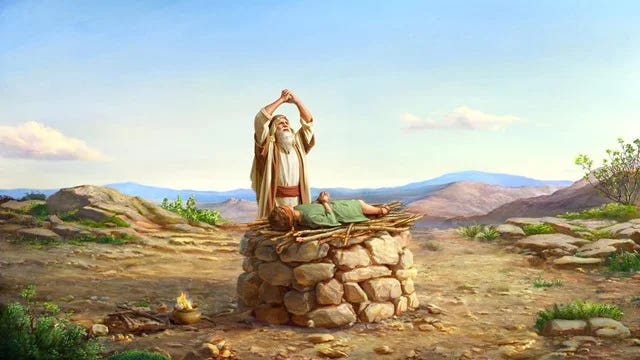
If the context of justification here is solely horizontal, who was Abraham trying to justify himself to? It wasn’t his servants that journeyed with him. He commanded they stay at the base of the mount while he and Isaac went up to offer sacrifices (Genesis 22:5). They couldn’t see anything. Was Abraham trying to justify himself to the son that he was confident he was about to slaughter as sacrifice to God? I don’ think so. Likewise, everything Abraham was about to accomplish was because of God’s command. There is no other person in this example, but God, that Abraham was concerned with seeing him in action.
V22 “You see that faith was active along with his works, and faith was completed by his works”
It is evident that here, faith is not producing the works of Abraham (as if they are merely associated), but his faith was active right along side his works, like one united thing working in tandem. This is made even more evident when James says that “faith was completed by [Abraham’s] works.” Faith and works are so inextricably connected, being of the same substance, that it is impossible for faith to even be completed without works. There isn’t just an association here, or one thing producing the other. This isn’t a “which came first” scenario. Both exist simultaneously, always.
V25 “And in the same way [as Abraham] was not also Rahab the prostitute justified by works when she received the messengers and sent them out by another way?
First, notice, how James says that whatever was true about Abraham was also true for Rahab. So, the same way his works justified him, is the same way her works justified her. Next, consider the story (Joshua 2:1-24) and think what Rahab had to gain by hiding the spies? One wonders who she was trying to prove herself to? It wasn’t Jericho, for they would seek to kill her for treason were they to discover her treachery, and it wasn’t the spies because she didn’t trust them and had to make them swear that they would not destroy her along with the city (V12). So, what horizontal element is there in regard to her justification? Who was she proving herself to? The answer is, there isn’t one. It was to God and him alone who saw how her works complete her faith. How her lying was glorious obedience, and how she chose the true God over false gods.
V26 “For as the body apart from the spirit is dead, so also faith apart from works is dead.”
This passage is also frequently distorted in order that it might fit within an already formulated theological framework. Notice the analogy. James uses something that we should understand instinctively and concretely in order that we might understand something that could make us scratch our heads in confusion. The body is compared to faith, and the spirit is compared to works. Both the body and faith are said to be dead apart from its activating agent. The body is activated or animated by the spirit, or to put it another way, apart from the spirit the body is dead. So too with faith. Faith is activated or animated by works, or to put it another way, apart from works, faith is dead.
The way that many in the reformed world will distort this passage is by saying that faith is actually the animating principle of works. However, James could not be more clear. Works activate faith and when this is distorted it should indicate to us that whoever says something so sideways is more beholden to a tradition than the biblical text.
What It All Means
“Faith, thus receiving and resting on Christ and his righteousness, is the alone instrument of justification; yet is it not alone in the person justified, but is ever accompanied with all other saving graces, and is no dead faith, but worketh by love.”
-WCF 11.2
As the Westminster Confession clearly states, “resting and receiving on Christ…is the alone instrument of justification.” Resting and receiving, however, are not passive, they are, in fact, active. Faith is often illustrated as “an empty hand receiving Christ” or as R. Scott Clark says, faith “leans” into Christ. In other words, when faith rests and receives it is working - it is obeying. Resting and receiving are thus, the works God commands the faith to do. Faith is commanded by God to rest and receive (Romans 3:25), and when faith does this, it is obeying; it proves itself to be alive, and is then qualified to be the instrument of justification. It is, therefore, a living faith; it is faithfulness. If it does not rest, receive, lean upon, reach out for, grasp, etc. it is disobedient and is a dead faith, and cannot justify.
The natural question to all this is then, “so if were justified by faith alone, and faith must be obedient (it must do what God commands it to do) to what God commands otherwise it’s dead, then what does that mean for justification?”
First, consider the reformed Ordo Salutis. Starting with election, what follows is calling, regeneration, conversion, justification, sanctification, and finally glorification. The conversion piece is always broken down into two parts, faith and repentance. So, for the reformed, repentance and faith precede justification. This means then that election, calling, and regeneration are monergistic. When we are regenerate, we are given a new heart by the Spirit of God (making us able to obey), we go from unholy to holy, were definitively sanctified (making us desire to obey), etc. Then, by faith, we obey God by resting in and receiving Christ, resulting in our justification. This means that justification is not monergistic, but is synergistic, because if the faith weren’t obedient then it would be dead, and no justification would ensue. And this is why James says that no man is justified by faith alone, but by faith and works.
Consequently, the being of faith, the ontology of faith is the leaning into, the resting upon, the receiving of Christ. This is what God commands faith to do - this is the kind of faith that God gives. Unless faith works it is not faith. Faith is lively, faith is obedience to God’s commands. And only a faith that does what God commands it to do can justify. Faith is ever accompanied by, and is always working through love, and there can exist no moment when it does not do this, else it would be dead.
James 2:26 For as the body apart from the spirit is dead, so also faith apart from works is dead.
Matthew Poole's Commentary on Romans 1:5
https://www.ligonier.org/learn/articles/does-james-deny-justification-by-faith-alone
https://www.ligonier.org/learn/qas/does-james-2-24-refute-the-doctrine-of-justification-by-faith-alone