Socialism and Communism as Ideological Kin
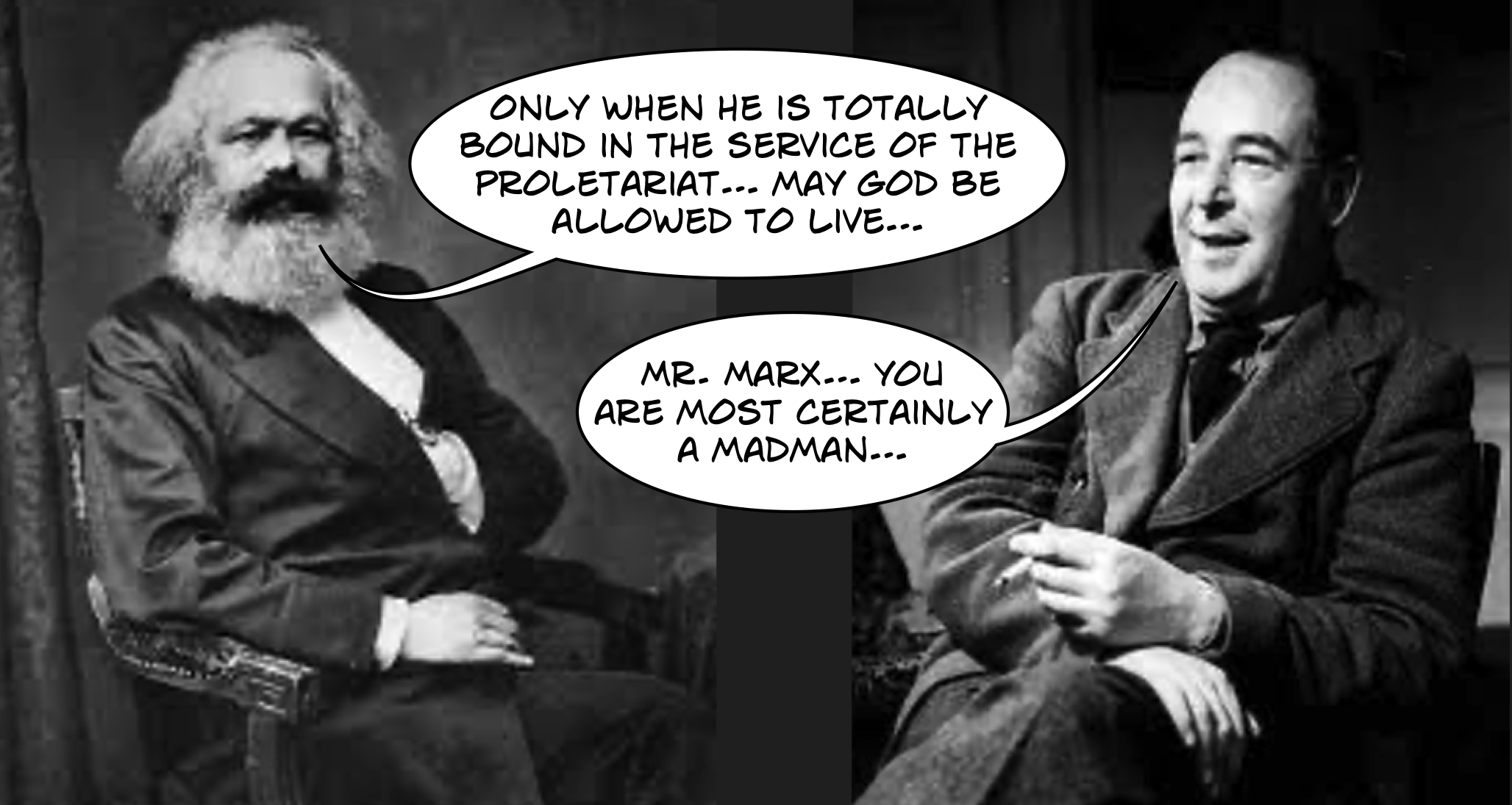
Recently, I was told by my peer that Communism and Socialism are not the same. Further, how foolish is the man who fails to distinguish them. When I posed the question, “What’s the difference?” there was a pause, with the follow-up, “One second. Let me look it up.” Later in the day I was sent a meme that read: “For f***’s sake, Socialism is NOT Communism. Capitalism: anyone can be rich, Communism: no one can be rich, Socialism: anyone can be rich, but no one should be poor.” I responded by saying, “it’s what the government does to ensure that no one is poor that makes socialism communism.”
Modern political discourse, from professional pundits to the average-joe-workin’-type often distinguish socialism from communism, treating the former as a moderate economic philosophy and the latter as a radical revolutionary ideology. Yet this distinction, though politically fashionable, collapses, like Biden down the Air Force One stairs, under theological, historical, and philosophical scrutiny. From a Christian perspective—grounded in Scripture’s doctrine of man, the limits of the civil magistrate, and God’s ordained spheres of authority—socialism and communism emerge not as distinct systems, but as two developmental stages coming from the same pagan worldview. Both share an identical root, an identical anthropology, and an identical eschatological aspiration. They differ only in tempo, not in telos.
Shared Anthropology
Every political system presupposes a doctrine of man. Scripture teaches that human nature after the Fall is radically corrupted (Gen. 6:5; Jer. 17:9; Rom. 3:10–18). John Calvin famously observes that the human heart is a “perpetual factory of idols” (Institutes I.11.8). Because of this, power concentrated in human hands tends invariably toward corruption (cf. 2 Sam. 11; Prov. 29:2). As Lord Acton has famously said, “Power corrupts, and absolute power corrupts absolutely.”
Socialism and communism both reject this doctrine of depravity by assuming that government can be benevolent and that its role is benevolence. However, regarding the civic realm, there is almost nothing further from the truth. God has given government one singular function: to reward the good and to carry out God’s wrath upon the wrongdoer (Romans 13:1-4). Its job is not to administer care, blankets, kisses and hugs; its job is the promotion of righteousness and the destruction of evil.
Socialism and communism, however, assume that its central planners—whether the people, the Party, or the proletariat—have not only the desire but the wherewithal to administer economic life with fantastical justice. But, from his own words, Karl Marx (a Jew), taught that “the theory of the communists may be summed up in the single sentence: abolition of private property” (Communist Manifesto, ch. 2). Yes. The best way to human flourishing is to abolish private property. However, this sentiment is not only starkly against all the knowledge of all antiquity, but is, most importantly against the word of God. The 8th commandment makes it immoral to steal anything from anyone, which necessarily requires that someone owns something that someone else takes without the permission of the owner—which makes it illegal, criminal, and immoral. This can be anything, including land. Yet his socialism-influenced predecessors (Babeuf, Fourier, Owen referred to by Friedrich Engels as “utopian socialists” and who distinguished their own work as “scientific socialism”) likewise envisioned centrally planned economic control for the common good. Yes...the common good.
Abraham Kuyper, the great statesman, theologian, and politician, however, identifies the foundational worldview issue: when a society denies the sovereignty of God over every sphere, the state naturally becomes the “all-embracing, all-controlling power” (Lectures on Calvinism, 79). Or as Doug Wilson puts it, “if there is no God above the State, then the State becomes god.” There will always be a supreme. It isn’t a matter of whether but which. And, when the government has become Godless, it will naturally assume divine power to itself, and because this is idolatry at the root, it is necessarily demonic, and demon controlled people love rebellion against God. Both socialism and communism, therefore, share precisely this anthropological confidence in fallen humanity and hatred of God. A misplaced trust, to say the least.
Shared Economics
Reformed ethics affirms the inviolability of private property under God’s law (Ex. 20:15; Deut. 5:19; Prov. 13:22). Johannes Althusius, an early Reformed political theorist, identifies stewardship, not collectivism, as the biblical principle of ownership (Politica, XXVII). The Westminster Larger Catechism even explicitly grounds private property in the Eighth Commandment, teaching that theft includes not only manual stealing but also unjust economic coercion (WLC Q.141–142). The point is, the notion of Christianity being even warm toward socialism and/or communism is not only rebuffed by the bible (which would be enough) but is also hotly rejected as devilish by the witness of church history.
Communism openly abolishes property whereas socialism merely transfers ownership of said property to the “collective,” which in practice means the state. This is how academics make distinctions to sound all smart n’ what not, but in reality what they are distinguishing has no difference but the paper it’s wrapped in. Friedrich Engels, explaining socialism’s trajectory, states: “The final result… is the abolition of private property” (Anti-Dühring, Part 3). Lenin agreed: “Socialism is merely the first stage of communism” (The State and Revolution, ch. 5).
It is, thus, either an intellectual deficiency, ardent ignorance, or blind disregard in the nature of socialism to see them as anything different; the very architects of these systems acknowledge their shared foundation and end.
Shared Politics
As noted above, the Christian tradition limits the civil magistrate’s authority to the administration of justice/destruction of evil and the preservation of civil order (Rom. 13:1–7; 1 Pet. 2:13–14). God has designed the government, in other words, to be a hammer wrapped in velvet. It is not a ministry for food stamps, disaster relief, or orphan care, those jobs belong to the church. God has intended it to be a blunt instrument to strike fear into the hearts of those who would disobey God. Calvin articulates this narrowly defined role in Institutes IV.20, calling the magistrate a “minister of God” whose jurisdiction is real but restricted to its delineated sphere.
In contrast, socialism and communism both require:
· centralized control of production
· redistribution of wealth
· state-administered equality
· bureaucratic oversight of economic and social life
This necessarily results in the expansion of political power beyond biblical (and rational) bounds. Kuyper’s doctrine of “sphere sovereignty,” as articulate in scripture (Matthew 28:18; 1 Corinthians 10:31; Genesis 1:28) explicitly prohibits the absorption of economic or familial functions into the political and governmental sphere (Sphere Sovereignty, 1880). The government simply has no right to overstep. It is the job of fathers and mothers to care for and educate children, provide for their welfare, and hand down generational wealth to their children. No father or mother should have any concern, whatever, for anyone else’s children but heir own beyond a generalized love. A man is responsible to care for, discipline, feed, and educate his children, not his neighbors children. Socialism and Communism, however, require that the money fathers make and the land fathers buy go to the collective—which necessarily means that their children get less. And, if you say to yourself something like, “wow, that sounds super selfish” then you are a commie and part of the problem.
It is undeniable that this absorption of other realms into the political real is precisely the operational mechanism of socialism and the perfected mechanism of communism. R. J. Rushdoony summarizes the trajectory succinctly: “Socialism is communism by the installment plan” (Revolt Against Maturity, 242).
Shared View of People
Biblical anthropology teaches that man bears the imago Dei, the image of God (Gen. 1:27). This means man bears dignity and moral agency individually—not as a mere component of a collective. Herman Bavinck warns that destroys and dissolves the individual into the mass necessarily denies the divine dignity of that person: “Personality is the core of human existence” (Reformed Dogmatics, II:566).
Communism, on the other hand, is explicit: the individual exists for the state. Socialism, however, is more cautious, (or shall I say shrewd with its language) insisting that the individual exists for the “common good”—but this is duplicitous nonsense. Who defines the common good? Who gets to determine if they’re right? It’s the state; in practice the collective is always represented, defined, and enforced by the state. Marx states: “The individual is the social being” (Economic and Philosophic Manuscripts, 1844). By using the word “is” he is discussing the very being of man—his ontology. That is to say, according the Marx, man has no value aside from this collective contribution. This is to make a man a shell of what a man ought to be. It is anthropology by subordination.
The Christian tradition, however, rejects collectivism, affirming subsidiarity as the faithful and biblical practice. Althusius insisted that societies are built “from the household outward,” not from the state downward, and that political authority is always derivative and limited (Politica, I). This idea, however, is repugnant to the liberal and socially minded because this necessarily means that everyone looks at his own wife and children as more important than anyone else’s. It offends his globalist and collectivist sensibilities because it means that life will not be “fair” for all. And this is of course true—some men are dead beats and some work diligently to provide. Some men are stupid, and some take great strides to be intelligent. Socialism and Communism, despising the reality of life and the truth of sin, reject this by placating to the lowest common denominator—they cater to weakness. This makes strong men angry, and weak men smug, and inevitably destroys all motivation, innovation, incentivization, and, eventually, civilization.
Shared Eschatology
Every political ideology carries an eschatology—a view of the future. Socialism and communism are no different. They share a secularized version of the Christian hope—bringing heaven to earth. Marx envisioned a future “classless society” where coercive institutions would disappear. Socialist writers such as Saint-Simon, Owen, and Fourier differed only in method, not in destination. Yet, the only problem is, because they have the same destination in mind, the socialists will be required to employ much (if not all) of the same tactics to achieve those ends. One cannot have a classless society without abolishing class; one cannot abolish class without equalizing a culture; one cannot equalize a culture without seizing the assets of the wealthy or granting the poor wealth—and both are vile practices of theft from two different directions.
This places both systems in direct conflict with Scripture, which locates the fulfillment of history not in human engineering, the removal of ownership, or the equalizing of outcome, but in Christ’s kingdom (Dan. 2:44; Rev. 11:15). The Reformed confessions insist that human sin—not economic structure—is the fundamental problem of society (Heidelberg Catechism Q.5; Westminster Confession of Faith, VI.2), the antidote to such a problem is repentance and faith in the Lord Jesus Christ!
Thus both socialism and communism rest upon a false gospel: redemption by policy, sanctification by redistribution, and glorification by political transformation. Not only is this blasphemy, but it has been an embarrassing failure everywhere attempted.
Historical Evidence: The Fruit Reveals the Tree
Our Lord teaches that “every tree is known by its fruit” (Luke 6:44). The fruit of both socialism and communism across nations is overwhelmingly consistent:
· centralized control of economic life (USSR, Maoist China, Cuba)
· coercive redistribution (all 20th-century socialist governments)
· suppression of dissent (East Germany, Venezuela)
· economic stagnation and scarcity (Soviet famine; Mao’s Great Leap Forward)
· bureaucratic expansion and corruption
· state surveillance and ideological indoctrination
Communist thinkers (Lenin, Marx, Engels) themselves declared socialism the necessary first stage of communism. Lenin made the distinction more concrete, arguing in The State and Revolution that socialism was the “first, or lower, phase of communist society”. In this phase, he argues, major industries would be state-owned, leading to the ultimate goal of communism, a society with no class distinctions or state. Historical practice has confirmed it. The systems differ not in substance but in the speed and degree to which the state concentrates control.
Conclusion: Different Degrees, Same Doctrine
Christians rooted in Scripture, holding to the historic confessions and the teachings of the historic church, and soberly aware of communist history can only honestly conclude that socialism and communism cannot be separated in essence. They share the same:
· anthropology (confidence in fallen human power)
· economic principle (state ownership)
· political theology (expanded magistrate)
· view of the individual (collectivist subordination)
· eschatology (human-engineered utopia)
To reject this reality is to reject the very teachings and direction of the founders and fathers of those movements, in which case, abandon communism altogether and embrace Christ and him crucified! Communism is socialism in its final form; socialism is communism in its preparatory form. They are ideologically and theologically unified systems whose shared root is the denial of God’s sovereignty, the concentration of power for the few, and the exaltation of human authority. For this reason, Christians must reject both as incompatible with biblical political order, Reformed doctrine, and just common sense.