Why Do So Many Churches Remove Children from Worship?
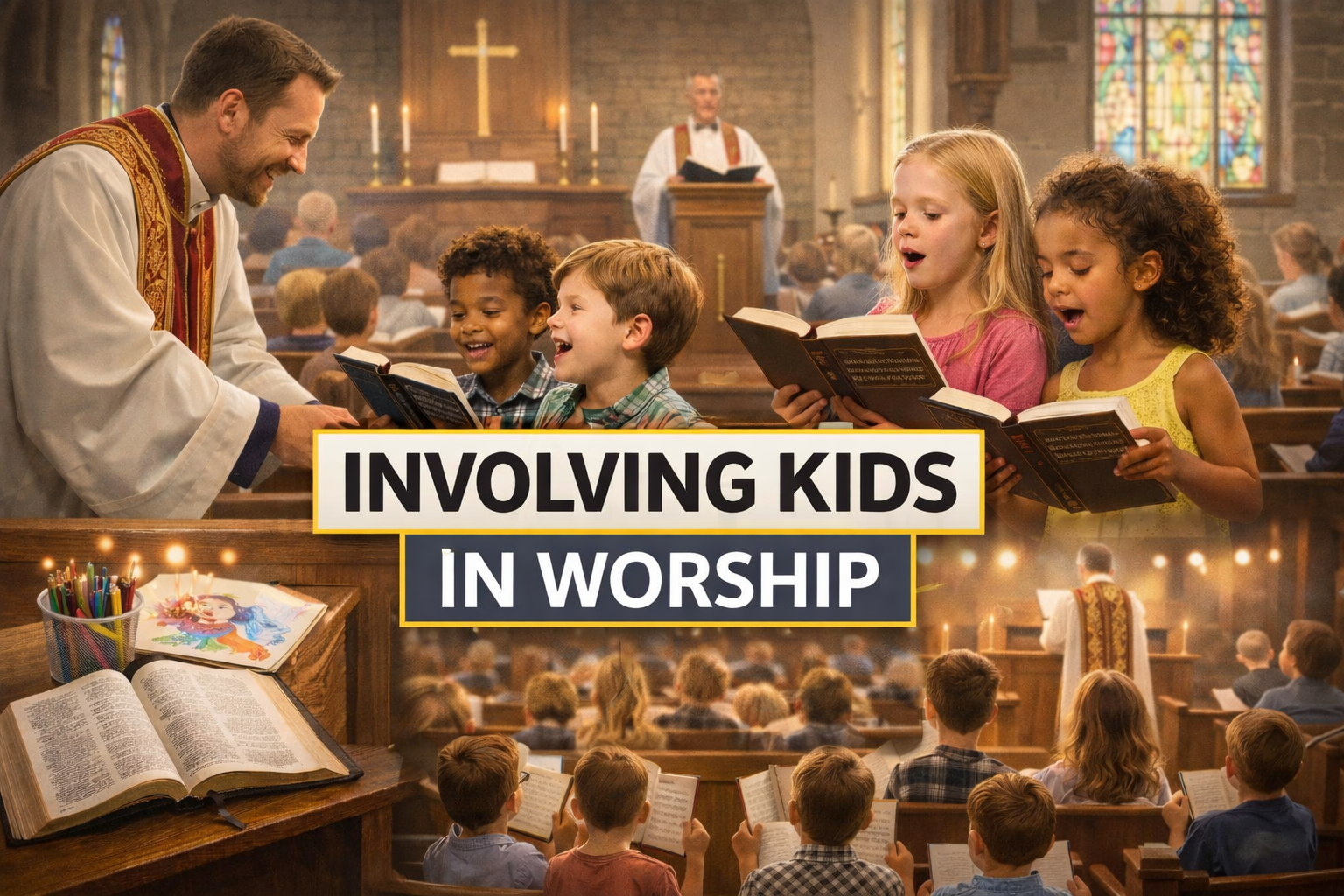
Recovering a Biblical Vision for Children in the Church
Introduction
Modern churches often assume that children do not belong in the gathered worship of God, because of this deep-seated belief, they are very often sent elsewhere: to nurseries, children’s church, youth wings, side rooms, and age-segregated programs. Meanwhile, the adults remain in what is often called “big church” or “real church,” as though the public worship of God only properly belongs to one class of people while everyone else must be managed elsewhere.
This arrangement has become so common that, as Dr. Ian Malcolm once remarked, many Christians are so preoccupied with whether they could segregate children, they didn't stop to think if they should segregate children.
A Modern Innovation, Not a Historic Practice
This should not come as a shock, but the removal of children from worship is not rooted in historic Christianity. It is, in its entirety, a product of modern assumptions in the church, most of which are borrowed more from secular culture than from Scripture.
This should also not shock anyone, but our age tends to also have a very low view of children. Rather than as a blessing, children are often viewed as burdens, interruptions, inconveniences, unwanted responsibilities, or just consumers who must be entertained. They are often seen as incapable of meaningful participation in serious matters and therefore in need of a simplified parallel experience tailored to their age and attention span. The church, in many places, has accepted this anthropology without much resistance or critical thinking.
The Bible, however, presents a very different vision of who and what children are. Scripture describes children as image-bearers of God, meaningful covenant members, heirs of the promises of God, and those who are to be brought up in the nurture and admonition of the Lord. In other words, they have intrinsic value; they have a future value; they are not outsiders hovering near the church until adulthood and/or intellectual prowess finally grants them entrance. Quite the contrary: they belong to the people/covenant/church of God and are commanded by God to be treated accordingly.
Children Addressed In The Apostolic Church
When Paul writes to the church in Ephesus, he says:
“Children, obey your parents in the Lord, for this is right.”
This little line, which can be easily missed, matters immensely because Paul addresses the children in the church directly. He does not tell parents to relay his message at a later time, nor does he hand off their discipleship to a separate ministry structure. No. Rather, he speaks to them as members of the gathered congregation because they were present when the letter was read publicly.
Men, women, and children heard the apostolic word together from their pastor in one place as one people. The assumption of the early church was plain: children were part of the assembly. This fact alone ought to cause churches that have children's church to reconsider what they now treat as obvious and unquestionable.
Distraction
One common objection from those in favor of the disjunction of children from parents is that children are distracting. They cry, wiggle, grow restless, eat, fuss, and sometimes test boundaries. They can make worship harder, interrupt sermons, and make the experience less enjoyable.
Now, it is certainly true that babies do fuss, cry, wiggle, and test boundaries. There is no argument there.
However, these Christians are allowing difficulty to be an argument against duty. Marriage is difficult. Parenting is difficult. Prayer is difficult. Sanctification is difficult. Reading is difficult. Compassion can be difficult. Cooking can be difficult. Patience is difficult. Many of the best and holiest things in life require patience, sacrifice, humility, and endurance. Regrettably, the modern instinct is to eliminate burdens rather than embrace responsibility, yet Christian maturity always grows through the very hardships we are tempted to avoid. We do not have the option of choosing an easy life - we are merely granted the option of which difficulty we wish to endure.
A church without the sounds of children may feel cleaner, less hindered, smoother, and more efficient, but this is a morphine drip to mask hemorrhaging. No children in the worship of God reveals a troubling reality about its future: it doesn’t have one.
Proverbs 14:4 says:
“Where there are no oxen, the manger is clean, but abundant crops come by the strength of the ox.”
A clean barn may appear tidy, but productive barns preparing for the future are messy, and a living church where children are present with all their noise and mess is the same way.
Children Learn by Presence
Many assume education is little more than the transfer of information into the mind, as though the child were merely a repository waiting to be filled with facts. This, however, is a grossly truncated view of biblical pedagogy. Biblical discipleship is worldview, ethnic, and cultural formation; it is a comprehensive method of tutelage to develop the whole person into a well-functioning individual who is totally committed to his legacy, land, and Lord.
Children learn by watching their fathers stand to sing, by hearing their mothers confess the faith, by observing families pray, by seeing the church raise their hands, by listening to Scripture read aloud, by seeing reverence, joy, repentance, and praise embodied before them week after week. Long before a child can articulate doctrine clearly, he is already absorbing a culture of worship, learning, and seeking to imitate. Just as John the Baptist leaped in the womb of Elizabeth when the Lord was present and near in Mary’s womb, we expect our children to have similar movements of faith in the assembly of God.
This is one reason removing children from worship can be so spiritually detrimental. It deprives them of years of ordinary formation that God uses to shape their souls.
Christ Welcomes the Praise of Children
When the children cried out in Jerusalem, and the religious leaders were offended, Jesus answered by quoting Psalm 8:2,
“Out of the mouth of babies and infants, you have established strength because of your foes, to still the enemy and the avenger.”
Jesus brings this passage into the New Testament this way:
“Out of the mouth of infants and nursing babies you have prepared praise.”
It is obvious from God’s own mouth that children are not obstacles to worship - instead, they are immensely beneficial and needful in worship. Notice what God says they are: they are the strength of God to defeat his enemies. Jesus quotes this passage and brings more clarity, saying that the way infants and babies defeat God’s enemies is by praising the Lord with the assembly. In order for children to be formidable warriors in God’s army, they must be trained up in it from the youngest age so that this worship of God gets into the marrow of their bones. This is God’s ordinary means of inculcation.
Children are therefore participants in worship. Their presence is not an embarrassment to be hidden, but is part of the beauty of God’s covenant people gathered before Him. Further, if we don’t want our children to abandon the church and Christ when they get older, we must communicate the beauty of Christ and his bride as early as possible.
The Real Issue Is Often Convenience
If we are honest, much of the modern model of church - and parenting for that matter - is driven less by theology and more by convenience. Because raising children is difficult, painstaking, sometimes annoying, stressful, and exhausting, parents are glad when the opportunity arises to be without their children for a time. But this is simply not an option parents have when they become parents.
God places the responsibility for raising, training, disciplining, and directing children squarely on the shoulders of parents, with all other help being purely supplementary. This means that when you have children, you should not be looking for others to do your job for you. But even when there is help, parents must evaluate whether it is genuinely helpful or a subtle attempt to shirk responsibility. Because God commands children to be in his worship and because children are covenant members just as adults are, any attempt to shuttle them off to another service can only be a devilish evasion of responsibility.
Parents may want uninterrupted services; churches may prefer polished environments; leaders may desire smoother programming; volunteers may feel more comfortable managing children elsewhere. Yet convenience has never been the measure of faithfulness. The real question is not what makes worship easiest, but what best conforms to the revealed will of God.
What Churches Should Recover
Churches should recover a normal Christian culture in which children are valued, welcomed, expected, trained, corrected, and gradually matured within the life of the congregation.
For this to occur, parents must once again take responsibility for discipline and instruction. They should completely abandon the idea that they can or may drop off their children in the nursery for someone else to watch. This move requires congregations to show patience and grace toward young families. It requires pastors and elders to encourage young parents to do what the Lord has called them to, regardless of their children's condition. It requires realistic expectations from the rest of the congregation, especially in the early years when children are small and growth is slow. It also requires long-term thinking and intentional preaching from the pulpit by the pastor.
Parents may miss portions of sermons while caring for little ones. The Lord’s day may seem like a burden at times. Parents may spend years going in and out of services, correcting behavior, and bearing the weight of training. Sermon recordings will include occasional screams and cries. Older adults may need to be intentionally and particularly inspiring toward younger parents. But those years are temporary, the work is a labor of love, the Lord desires parents to engage in this work, and when done in faith without grumbling, the peaceful fruit of righteousness that is produced will last for generations.
Conclusion: A Church With a Future
Across America, the church is aging rapidly. Christians now have a median age of roughly 54, which is significantly older than the religiously unaffiliated (nones), whose median age is around 38. Despite new data showing a rapid increase in church attendance among Gen Z and Alpha, older adults still remain far more likely to attend weekly worship services, give consistently, volunteer, and serve in leadership roles, while younger adults are underrepresented in most congregations.
Sadly, many churches now depend heavily on retirees and older households to sustain attendance, finances, and ministry labor, while the youth, with their strength, children, and dollars, are regrettably absent. This is especially evident in mainline Protestant, rural, and legacy congregations, where younger generations were often not retained or replaced, mostly due to the practices explained above. In practical terms, numerous churches are facing not merely spiritual decline, but a demographic decline: deaths are outpacing conversions, aging members are not being replaced by young families, and institutions lacking clear conviction or a compelling identity are struggling to attract the next generation.
Yet where churches offer reverence, doctrinal clarity, strong community, meaningful purpose, and the unapologetic inclusion of children and babies in the worship of God, we are seeing a resurgence of younger men and families filling the pews.
These kinds of churches, full of children, may be louder, messier, less polished, less corporate and professional looking, and with fewer programs to offer, but they possess something many other churches have lost: a future.
The sound of little voices in worship, the cries of nursing babes, and the tiny hands raised during the doxology all make a delightful sight and sound to the Lord - these are the sounds and sights of real covenant continuity. It is one generation declaring the works of God to another. It is the church trusting the ordinary means of grace and laboring for its posterity despite the momentary difficulty it presents.
So, wherever you are, stop shirking your duty by shuttling off your kids to a nursery worker or “youth minister.” Do the hard work the Lord has called you to - be a Christian parent.